
|
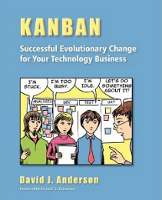
Kanban: Successful Evolutionary Change for Your Technology Business By David Anderson The book provides specific and useful guidance to those attempting to adopt kanban management in software development (as I am). The books is very well written and presents the material in a very easy to digest manner. It is so packed with information it is very difficult to mine even a significant portion of the value in one read. The organization allows for easy reference as you need to focus on any specific topic to find that topic and get an excellent review in minutes. |
|
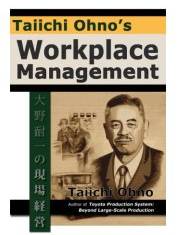
Workplace Management by Taiichi Ohno, translated by Jon Miller. Taiichi Ohno is known as the father of the Toyota Production System (TPS), also called lean manufacturing. He dictated the text to the Japan Management Association (in a series of interviews in 1982), which gives the book a sense of listening to him talk about the ideas. I found the conversational tone made it very easy to read and reminiscent of Dr. Deming's tone in many places. The book also provides a background for understanding one piece flow, just in time thinking, etc... More information on Workplace Management |
|
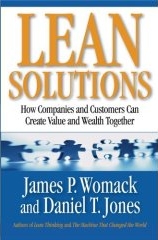
Lean Solutions : How Companies and Customers Can Create Value and Wealth Together By James P. Womack and Daniel T. Jones. "In this landmark new book, James Womack and Daniel Jones deconstruct this broken producer-consumer model and show businesses how to repair it. Across all industries, companies that apply the principles of lean consumption will learn how to provide the full value consumers desire from products without wasting time or effort -- theirs or the consumers' -- and as a result these companies will be more profitable and competitive." |
|
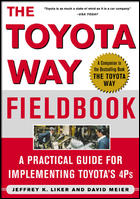
The Toyota Way Fieldbook:a Practical Guide to implementing Toyota's 4Ps by Jeffrey Liker. For this book he is joined by David Meier, and they delve into applying the concepts from his excellent book: The Toyota Way. Toyota's 4Ps: Philosophy, Processes, People, and Partners. "The Toyota Way Fieldbook details the language, concepts, and tools that managers need to use Toyota's success-proven practices in any organization. Readers are given valuable insights into the company's system and culture along with diagnostic tools, work sheets, and exercises-many adapted directly from Toyota originals." |

|
The classic Statistics for Experimenters has been updated by George Box and Stu Hunter, two of the three original authors. Bill Hunter, who was my father, and the other author, died in 1986. Order online: Statistics for Experimenters: Design, Innovation, and Discovery , 2nd Edition by George E. P. Box, J. Stuart Hunter, William G. Hunter, 2005. I happen to agree with those who call this book a classic, however, I am obviously biased. Google Scholar citations for the first edition of Statistics for Experimenters. More on Statistics for Experimenters Text from the publisher on the 2nd Edition: Rewritten and updated, this new edition of Statistics for Experimenters adopts the same approaches as the landmark First Edition by teaching with examples, readily understood graphics, and the appropriate use of computers. Catalyzing innovation, problem solving, and discovery, the Second Edition provides experimenters with the scientific and statistical tools needed to maximize the knowledge gained from research data, illustrating how these tools may best be utilized during all stages of the investigative process. The authors’ practical approach starts with a problem that needs to be solved and then examines the appropriate statistical methods of design and analysis. |
| Beating the System: Using Creativity to Outsmart Bureaucracies by Russell L. Ackoff and Sheldon Rovin. From the publisher: "The authors begin by exploring how systems function and malfunction, where their weaknesses are, and what drives them. They show that much of bureaucratic power is based on unchallenged assumptions--assumptions systems make about themselves and us, and assumptions we make about these systems and ourselves, and that challenging these assumptions is the essence of creativity and the first step in system beating. Ackoff and Rovin use stories to illustrate successful strategies and tactics for defying these assumptions and turning the tables on the many bureaucracies that frustrate us." | |
